Moving an underwriter off FileMaker without stopping the business
Bascule Underwriting runs on FileMaker systems we built together over many years. We are moving them to the web one area at a time, with the web reading FileMaker live, so each part changes over while Bascule keeps writing business.
- Client
- Bascule Underwriting
- Moving
- FileMaker to the web
- How
- One area at a time
- Moved so far
- Claims, policies, agencies
Too much of the day to switch off in six weeks.
The problem. FileMaker sits in every part of Bascule's day: policies, horses, invoices, claims and commission. Around it had grown online forms, claim boards, a helpdesk and a chain of nightly exports and spreadsheets. Switching all of it off at once was never an option for an underwriter that has to be right every day.
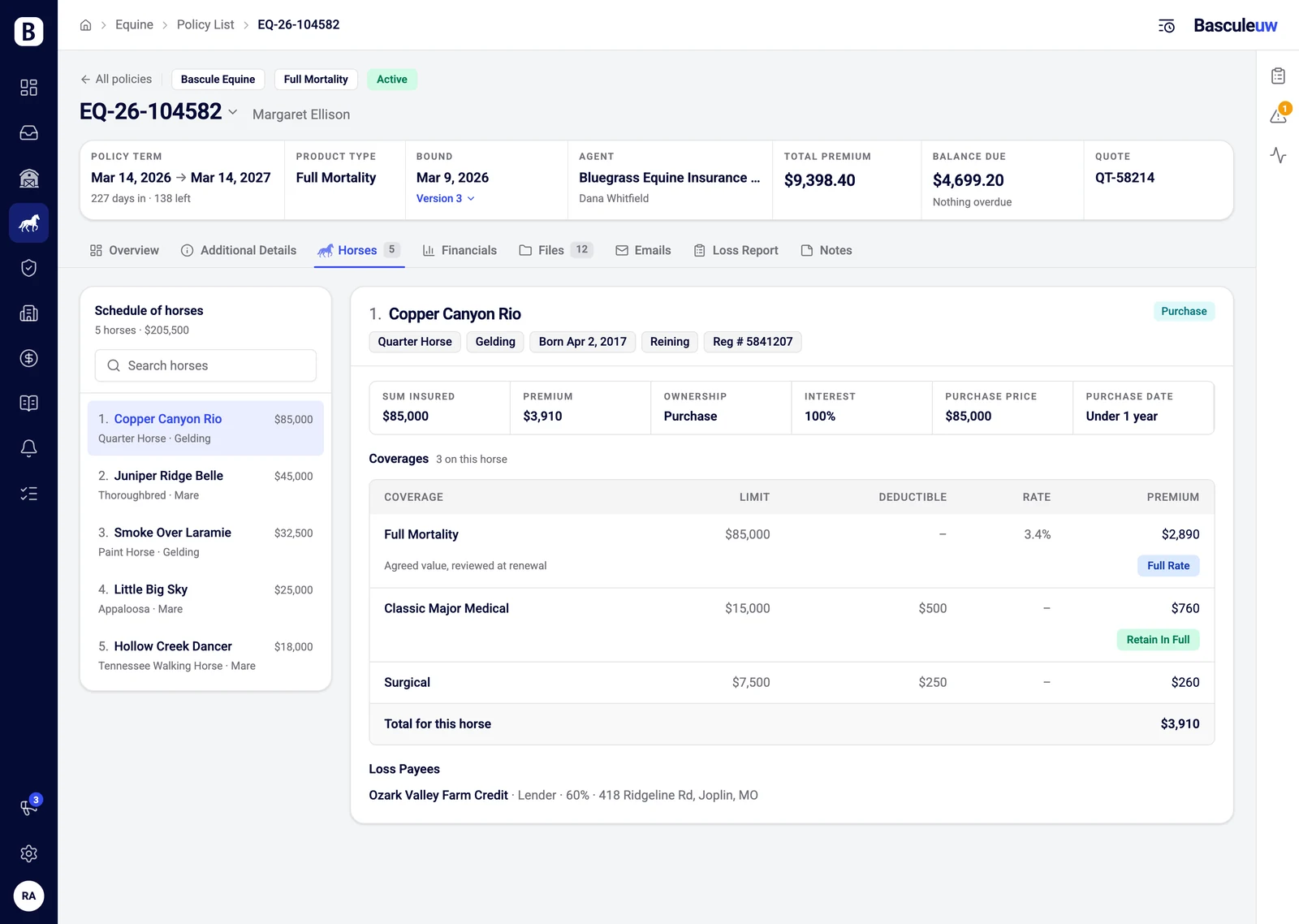
The approach. We move one area at a time. The web reads policies, horses and invoices straight from FileMaker, writes back where FileMaker still needs it, and keeps its own records for what is new, so each area goes live on its own while the rest carries on as it was.
The same claim, before and on the web.
Drag to compare. On the left, the kind of screen a database built up over many years becomes: everything at once, every field the same weight. On the right, the claim in PolicyHub, with the horse's history refreshed from FileMaker and each change marked.
Two screens of one claim: before, a dense grey database screen drawn as a wireframe, with a column of look-alike buttons, two rows of tiny tabs, a wall of identical fields and cramped grids; on the web, the claim in PolicyHub, with the claimant, the horse and the agency down the side and the horse's policy versions refreshed from FileMaker, the version in force at the loss marked and its changes listed as added, removed and updated.
One area at a time, while the business runs.
Each area crosses to the web when it is ready. Until then, and for whatever still lives in FileMaker, PolicyHub reads it live and writes back where FileMaker still needs it.
Bascule's areas moving off FileMaker one at a time: claims, vet reports, policy records, horse history, agencies and commission statements cross from the FileMaker side to the web, while quote binding and payments are still to come. Between the two ends, a live link: PolicyHub reads FileMaker live and writes back to it.
What has moved so far
Each area replaces FileMaker layouts or a separate tool, and the data stays where it lives until it is ready to move.
- Claims, out of FileMaker and the claim boards, into one list, a kanban and a workbench
- The vet report, from an online form tool to a secure link of Bascule's own
- Equine and farm policy records on the web, with every FileMaker version and what changed in each
- Each horse's history on a claim, refreshed from FileMaker, with the changes marked
- Agencies kept in PolicyHub and written back to FileMaker at every save
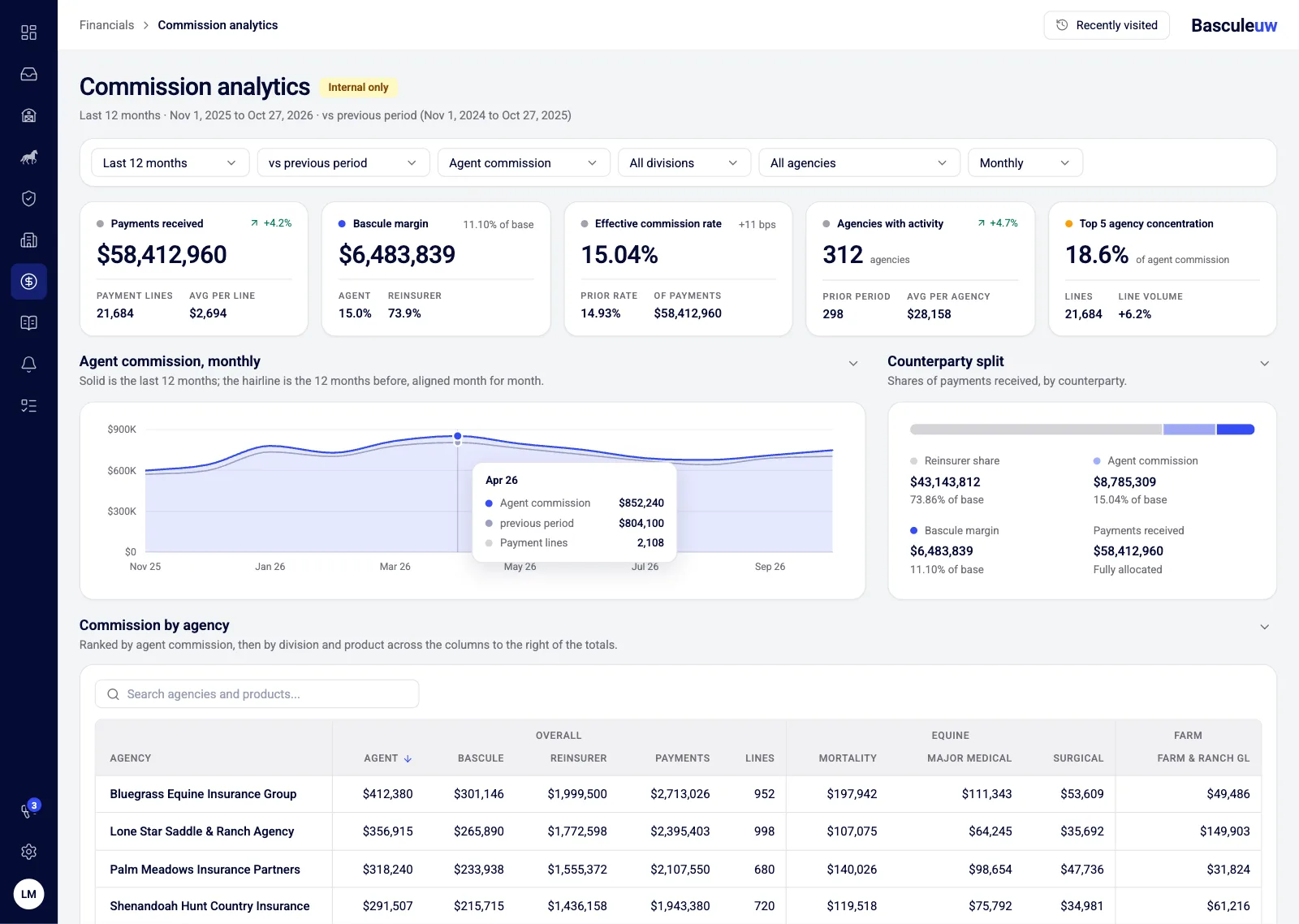
- Commission statements on the web, the first step off the chain of exports and spreadsheets
How each area moves
Read live
The web reads the area's records straight from FileMaker, so nothing is copied and nothing goes out of date.
Build on the web
The screens are built in PolicyHub, and anything new is kept in Supabase under its own access rules.
Write back
Where FileMaker still needs a change, PolicyHub writes it back the moment it is saved.
Open by flag
A PostHog flag opens the area to Bascule's team first, then to each agency when it is ready.
Switch over
Once the area runs on the web, the FileMaker layouts or the separate tool behind it stop being used.
Where it stands
Claims, policy records, agencies and commission statements now run on the web, and every move happened while Bascule kept writing policies.
The rest of the FileMaker layouts follow the same way, one area at a time, each switched over when it is ready.
What we used
- FileMakerWhere policies, horses and invoices still live, read live by the web
- Next.jsThe web modules, inside PolicyHub
- SupabaseThe records that are new on the web, with their access rules
- PostHogFeature flags, to open each module when it is ready